




SUMMARY
Insect attacks: overview, mechanisms and consequences
How to reduce insect pressure on your crops?
Insect attacks: overview, mechanisms and consequences
- The current situation shows increasing insect pressure (e.g. aphids, flea beetles, pollen beetles, etc.) and a constant decline in the number of available active substances.
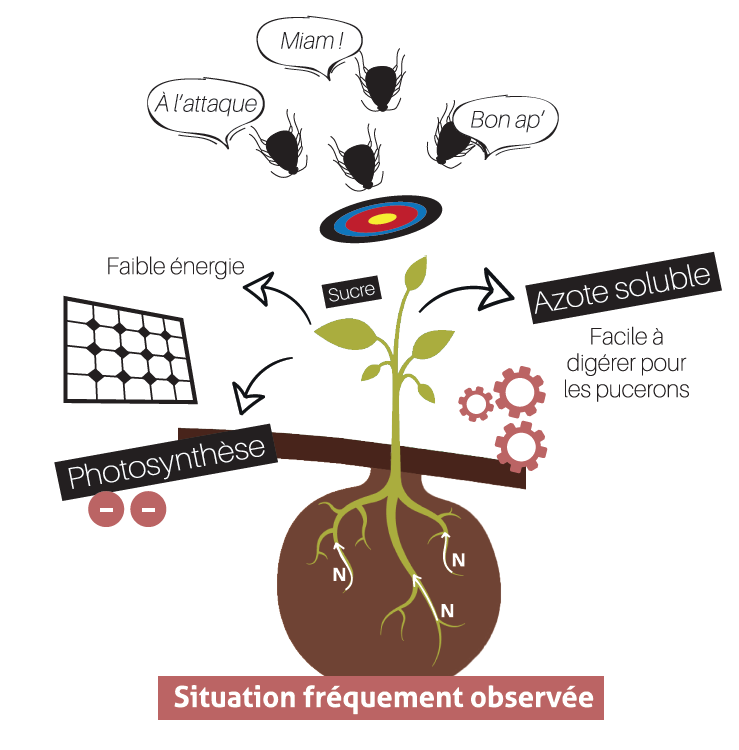
- How do insects feed? By sucking the plant sap, mainly on the underside of the leaves. Insects are also virus vectors that can lead to yield losses.
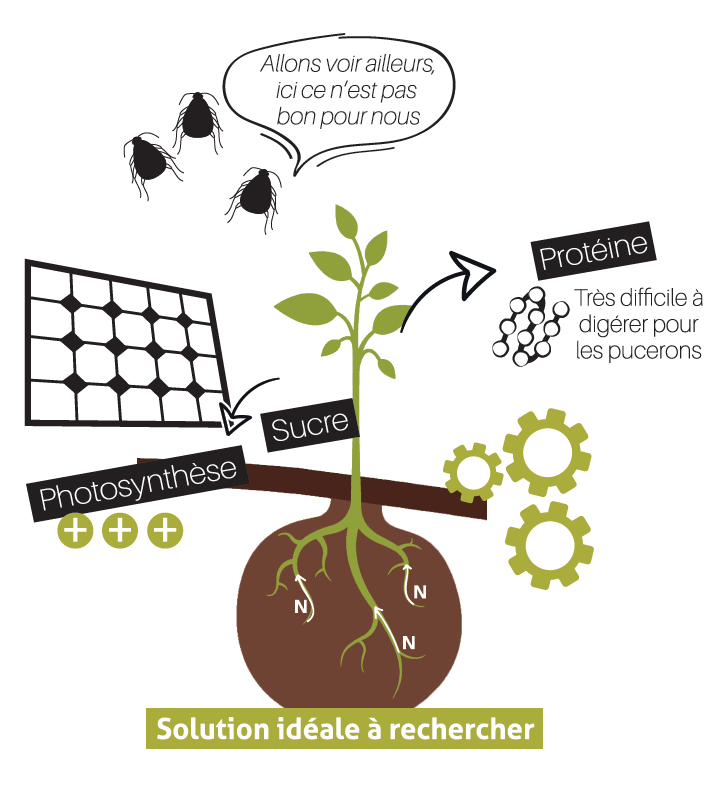
- Why is one plant more affected than another? Insects are attracted by an excess of soluble nitrogen in plants. However, they have difficulty digesting sap rich in large molecules such as proteins. Therefore, the more soluble nitrogen a plant contains, the more it favours insect development and population growth; conversely, the richer it is in proteins, the less it is targeted by insects.
- Consequences: A plant attacked by insects is doubly weakened.
- The consumption of its sap by insects exhausts the plant, affecting its growth and functioning, which leads to lower yields.
- Insects also act as virus vectors, notably those responsible for diseases such as Barley Yellow Dwarf Virus (BYDV) or Wheat Dwarf Virus (WDV).
How to reduce insect pressure on your crops?
By using VERTAL GRANDES CULTURES
- How?
Thanks to its antioxidant core and specific properties, VERTAL GRANDES CULTURES enhances photosynthesis, maximises sugar and protein production, and reduces the level of soluble nitrogen in the plant.
A crop rich in protein and low in soluble nitrogen is less attractive to insects.
- How to measure and assess it?
With a simple measurement of nitrate levels (NO₃⁻) and plant sap pH.
Target values:
- Optimum nitrate level: between 500 and 800 ppm
- Optimum pH: 6.4
Although often unknown to the general public, the regulation of fertilisers within the European Union is a complex system of standards and procedures that directly affects all market stakeholders. From product design to market placement, each stage is governed by national and European rules aiming to ensure user safety, environmental protection and product quality. In […]
...In an agricultural context where every action matters, it is essential to quickly and easily assess crop health directly in the field. The NUTRISCOPE, an innovation by SENSEEN & VERTAL, was designed to provide agricultural advisors and farmers with a simple, accessible, and fast solution for analysing the mineral fertility of arable crops (wheat, maize, […]
...For months, excessive and continuous rainfall has shaped the agricultural landscape, disrupting farming practices and crop yields. This weather pattern, far from being without consequences, has particularly affected the quality of forage – a key component in livestock nutrition. Content Understanding the issue Consequences for livestock farmers Solutions and adaptations Conclusion Understanding the issue Forage […]
...